Refactoring for a Feature: Unity Inspector Cleanup on Project E.G.G.
The Game
Project E.G.G. was an educational web-based game developed at Champlain College's Emergent Media Center and tested with elementary school students. You play as a small robot tasked with restoring a dying planet — but you never start from scratch. Every session picks up the world exactly where the previous player left it, for better or worse depending on the choices they made.
That persistent handoff is the mechanic that makes the game work as an educational tool. It teaches consequence and collective responsibility: the planet's health when you arrive is someone else's legacy, and the state you leave it in becomes someone else's problem.
The Problem
The world is populated by spawnable resources — trees, rocks, grass,
flowers, soil. Each type had its own
ResourceSpawner
MonoBehaviour on the same GameObject, every one of them carrying a
single prefab field and a single count field. Seventeen resource
types meant seventeen stacked components in the Inspector.
That was inconvenient, but the real cost was architectural. The persistent handoff mechanic requires loading saved resource positions from a database on session start and writing them back on quit. Doing that cleanly across N separate components, each managing one resource type independently, was going to be messy. The Inspector problem and the database problem had the same root cause: the resources weren't being treated as a collection.
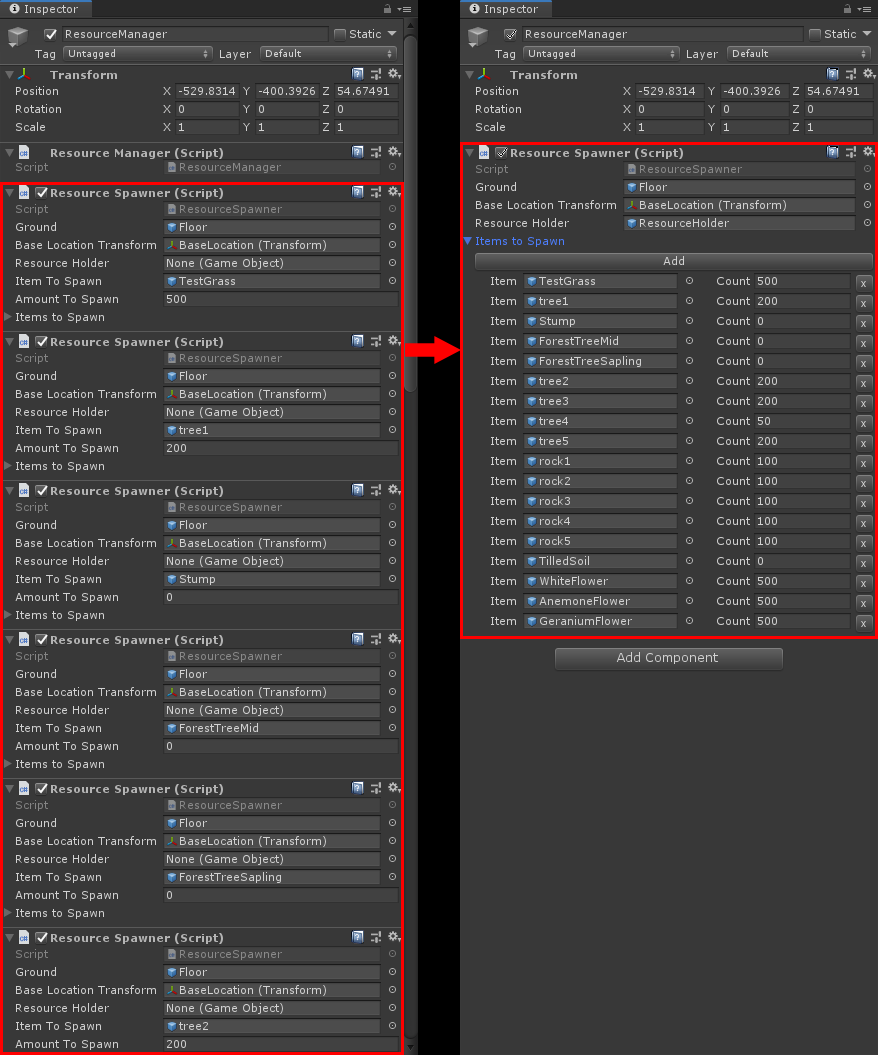
The Solution
A single
ResourceSpawner
MonoBehaviour holds a
List<Resource>
, where
Resource
is a small serializable inner class pairing a prefab with a spawn
count. On
Awake()
, the component calls
DatabaseDataHandler.LoadWorld()
and restores each resource to its saved positions — or generates
random placement for anything that's new. On quit and on the
EndGame
event, it writes the current positions back.
The Inspector cleanup followed naturally from treating resources as
a list. A custom
ResourceSpawnerEditor
renders the list as a collapsible foldout with an Add button,
per-entry delete controls, and a count field clamped between 0 and
50,000. The editor code lives in an Editor-only assembly and is
stripped from builds entirely.
The Diff
The diff below covers
ResourceSpawner.cs
. The before version is the per-type component; the after version is
the consolidated component with database persistence, event system
integration, and
RNGCryptoServiceProvider
-backed random placement.
ResourceSpawnerEditor.cs
is new — there was no custom Editor before the refactor.